-
- 8 x
-
https://torno.lv/xzWAWWd
Some want to learn to save, while others think it`s better to learn to earn more. Meanwhile, many successful people openly claim that the secret is in balance: first, master money-saving methods and then start looking for ways to improve them. Millionaires report this in their numerous interviews, and the most interesting tips become aphorisms and spread on the internet.
We decided not only to read quotes from famous people but also to implement them in life. And we found 5 “no’s” and 5 “yes’s” that those who dream of forgetting about money problems urgently need to know.
Continuation of the article
1st “no”: stop focusing on money savings.
One of the most famous 20th-century entrepreneurs and inventors, Henry Ford, said: “Old teachers teach us to set aside money until better times. This is very bad advice. Don`t save money in the bank. Until the age of 40, I haven`t saved a dollar; everything was invested in further development.”
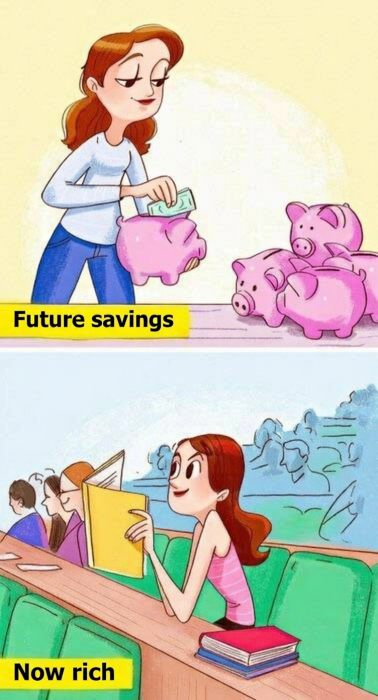
Investments in yourself can change your life. Such investments are not subject to inflation: no matter what happens, good health, education, and knowledge of several languages will be valuable. The more skills you have, the more chances for success in this life.
3 main groups of investments:
• skills and abilities: education, reading, courses.
• physical health: proper nutrition, vitamins, doctor visits, sports.
• mental health: rest, communication with friends, entertainment.
2nd “no”: forget about uncertainty
One of the best practitioners in time management, Bodo Schäfer, recommends: “We must do it, not try. Whoever wants to try is ready for failure. And in the end, nothing works out for them. There are no tries. You either do it or you don`t.”
When starting any endeavor, wealthy people are set on success. They don`t see obstacles and invest all their efforts to get what they want. People who later earn wealth are guided by the fact that “it will work because I will make it work.” And they don`t do it superficially. Poor people often sin with such behavior, don`t know what they want from life, and justify themselves with phrases like “Well, at least I`m trying,” “If anything, I`ll try something else.”
3rd “no”: don`t think about others` conveniences
Each of us has agreed to something when we really wanted to say “no.” Entrepreneur Warren Buffett is in the top three richest people in the world; he has earned billions starting from knowing nothing, so it`s worth listening to him: “If you have a choice, it`s much more important to say ‘no.’ This skill is very important: if we talk about others, there`s a risk of falling into the captivity of others` desires and forgetting about your own goals.
Often, parents unknowingly teach children wordless obedience: you can`t object, you can`t make noise. In adult life, it`s sad that a person will be afraid to express their true feelings. It could be a loveless marriage, unloved job, communication with unpleasant people. But our body knows how to say ‘no’ for us - if, for example, the job is not satisfying, the body will say ‘no’ with frequent illnesses.
4th “no”: don`t buy attributes of a rich life
Entrepreneur Mark Cuban grew up in a simple family but managed to become a billionaire and owner of a basketball team. He believes it`s not worth focusing on material things: “It doesn`t matter what car you drive. It doesn`t matter how you dress. The more you think about money, the harder it is to concentrate on goals. The cheaper you can live, the more options you have.
Many, after a salary increase, start spending more - buy a more expensive car, go to stores more often, order food. In the end, they don`t become rich; their shortage remains about the same level. Only if you earn more and spend less, there will be free funds that can be invested in your development.
5th “no”: don`t waste time in vain
One of the main modern business geniuses, the founder of the Starbucks coffee chain, Howard Schultz, noted: “Great achievements are not accidental.” Many want to quit their office job and do what they like: become a photographer, traveler, or writer. But it`s better not to do that until there is financial stability.
The most successful option is to live on income from the main job and pursue your dream job in free time. You can get up a couple of hours earlier, use the lunch break, engage in your favorite work in the evenings instead of watching series. If the money from the additional work is enough to pay bills and daily needs, then you can leave the boring place without fear.
1st “yes”: look for quality items
Such a statement from one of the richest people on the planet, Warren Buffett, may seem strange, but he says: “I don`t care if it`s about socks or stocks: I like to buy quality goods at reduced prices.”
Price is what we pay, but value is what we get. However, losing your head in sales is not the best idea, as you might take a lot of goods you don`t need and spend money on nonsense. Be selective when choosing necessary things, look for the ideal “price – quality” ratio, avoid impulsive purchases, and then you will manage to keep your hard-earned money.
2nd “yes”: focus on opportunities
The famous self-development book author Robert Kiyosaki is convinced: “‘It`s impossible’ blocks your potential, but the question ‘how can I do it?’ makes your brain work at full capacity.” It is this message that activates the brain, and it starts looking for solutions. “Impossible” is just a word, and even the most expensive dreams turn into reality.
This should be taught to your children, without limiting their potential, tell inspiring stories about people who have changed the world, and convince them that everything is possible; you just need to improve yourself and your life.
3rd “yes”: value what you have
And another wise saying from Warren Buffett: “Buy only what you would happily wear if the market closes for 10 years.” Shopping in stores is sometimes equated by modern psychologists to therapy: buyers want to get quick pleasure from impulsive shopping. The short euphoria ends with regret when the acquired item gets boring or goes out of fashion.
It`s better to buy a more expensive wardrobe item but from quality materials. But if you want to be in trend, you can join the conscious consumption and eco-shopping movement. People who care about their financial situation and the planet`s future exchange things, buy necessary items from other people, shop in second-hand stores, and use the same gadget for years.
4th “yes”: learn to see many small things in one big one
General Dwight Eisenhower owns the saying: “Plans are nothing. Planning is everything.” The first is the goal, but the second is the path and vision of how the goal will be achieved. Even if everything changes beyond recognition in a few seconds, the planning process itself will allow a deeper dive into the situation and adjust actions so that the goal is achieved. It will be easier to allocate time between tasks and not waste it. Plus, you won`t forget about the smallest things.”
5th “yes”: and finally, rest more
The name of the first official dollar billionaire, John Rockefeller, is known to everyone, and here`s what he recommends: “Whoever works all day has no time to earn money.” This means that if you work every day without lifting your head, you simply won`t see the world as it is. Without a fresh and clear view, there can`t be success at work.
Bill Gates supports this idea, claiming that “business is a game where maximum excitement combines with a minimum of rules.” And you shouldn`t turn the game into routine. Know how to disconnect so you can fill up with new ideas.”
Do you follow any rules or tips on economy and earning? Can you recommend any methods, techniques, or books that helped you improve or maintain your financial situation?
Liked what you saw? Recommend to friends
Next post